
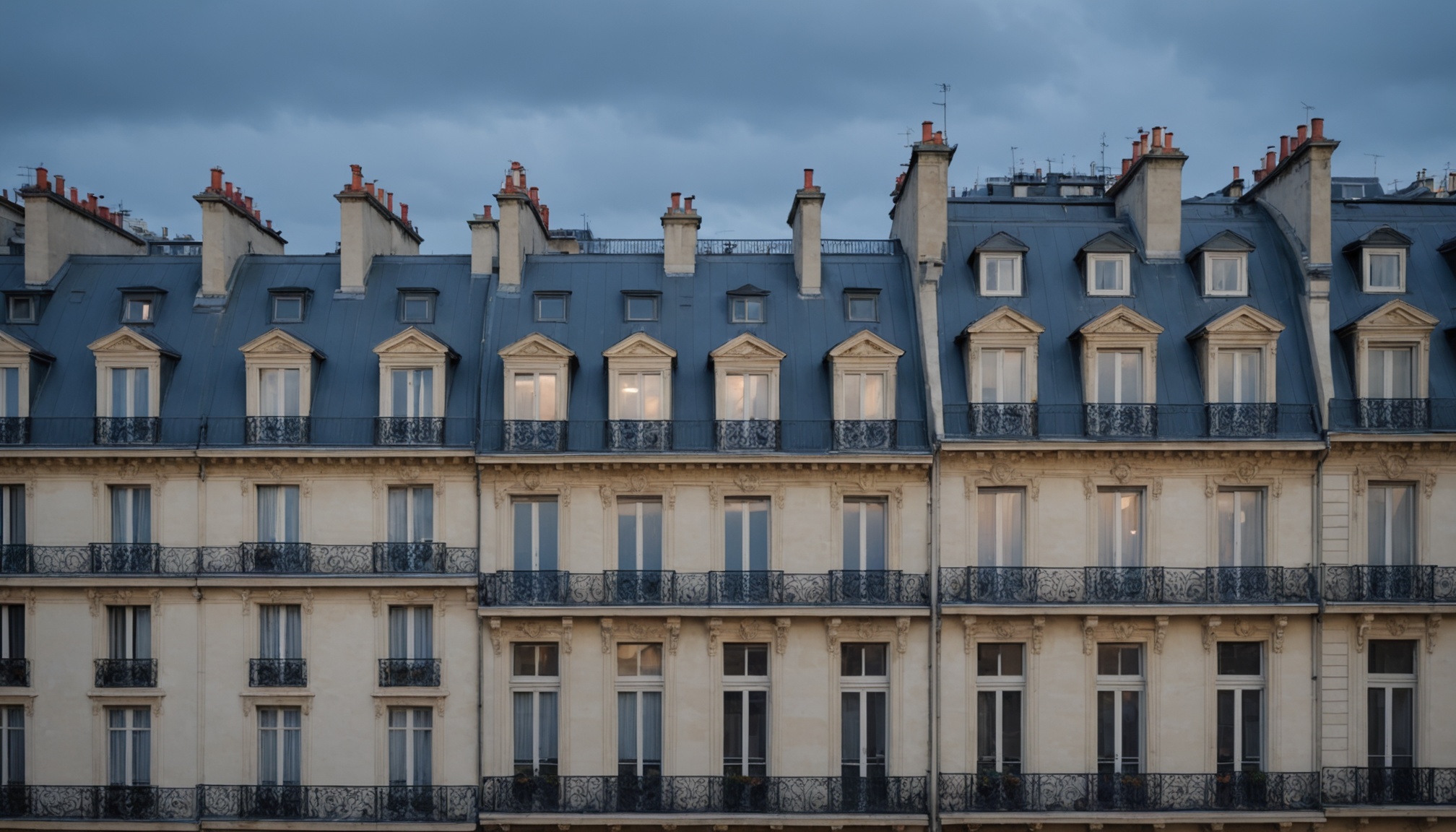
The electricity consumption in Paris stands out as an exception on the French landscape. In 2025, a Parisian household connected to the Enedis grid used an average of 2,602 kWh, compared with 5,354 kWh for a household in Tarn-et-Garonne: half as much, give or take a few kilowatt-hours. This isn't a matter of virtue, but of walls, square footage, and boilers, as shown by a study that cross-references consumption, income, and the regulated tariff.
An Unprecedented Map of Household Electricity Use
Three public agencies publish their figures without ever cross-referencing them. Every autumn, Enedis releases the consumption data from its 34,229,966 residential meters, broken down by department and municipality. INSEE measures residents' median standard of living. The Commission de régulation de l'énergie (the CRE, France's energy regulator) sets the Tarif Bleu, the regulated electricity rate. The study published by Comparons l'énergie on October 25 placed these three sources side by side for the 94 departments served by Enedis and more than 32,000 municipalities. From them, it derives a standard bill, calculated using the same rate everywhere (Base 6 kVA as of August 1, 2026: €190.81 in annual subscription fees and €0.2001 per kWh), along with an indicator that weighs it against local standard of living.
At a single flat rate, only consumption shows through. For the capital, the standard bill comes to €711 a year, the lowest in France, compared with a national average of €1,016.
Paris, Dead Last in the Ranking
Paris ranks 94th out of 94 departments for consumption, billing, and its share of standard of living. Among municipalities, the city ranks 24,885th out of the 25,217 municipalities with 100 meters or more: only 332 are more frugal.
The reasons have to do first with housing stock. According to the Paris profile, 97% of homes there are apartments, and nearly half of primary residences were built before 1946. An apartment shares its walls with neighbors, heats little floor space, and has no pool, garage, or outbuilding. And 39.9% of Paris homes are under 40 square meters, nearly double the share in Hauts-de-Seine (22.1%).
Yet Paris's case holds a surprise. Electric heating is not marginal there: 34.6% of primary residences are equipped with it, and the share of consumption that varies with temperature reaches 21.4%, slightly above the national average of 19.9%. But a space heater warming a two-room apartment uses far less than a system heating a large house. It's the size of the home, more than the energy source chosen, that accounts for Paris's frugality.
The Inner Suburbs, Between Gas and Collective Heating
The three neighboring departments follow close behind Paris. Hauts-de-Seine shows 2,867 kWh per household and a standard bill of €764, Val-de-Marne 3,084 kWh and €808, Seine-Saint-Denis 3,090 kWh and €809. Multi-unit housing remains dominant there (87.9% in Hauts-de-Seine, 77.3% in Val-de-Marne, 75.7% in Seine-Saint-Denis), and electric heating is less common than elsewhere: 24.3%, 21.4%, and 21.8% of primary residences, respectively, compared with 41.3% in Tarn-et-Garonne. In these buildings, heating often runs through a gas boiler or a district heating network, paid through condo fees rather than on the electricity bill—which is sometimes a good reason to switch property management companies to cut costs.
The study quantifies this link: the more apartments a department has, the less its households consume, with a correlation of −0.57. Every department where more than 45% of households live in apartments falls in the bottom of the ranking.
The Outer Suburbs, Already a Different France
Beyond the first ring, the landscape changes. Yvelines (4,138 kWh, €1,019), Essonne (4,131 kWh, €1,017), and Val-d'Oise (4,085 kWh, €1,008) match the national average. Seine-et-Marne, with only 43.1% apartments, climbs to 4,701 kWh and €1,131: it ranks 19th out of 94 for billing, much closer to rural departments than to Paris. Detached houses are common there, and equipment choices weigh heavily, as our feature on the secrets of an eco-friendly, cost-effective home points out.
| Department | kWh per household (2025) | Standard bill | Share of standard of living | Change since 2019 |
|---|---|---|---|---|
| Paris | 2,602 | €711 | 2.1% | −11.5% |
| Hauts-de-Seine | 2,867 | €764 | 2.3% | −12.8% |
| Val-de-Marne | 3,084 | €808 | 3.0% | −10.5% |
| Seine-Saint-Denis | 3,090 | €809 | 3.8% | −11.2% |
| Yvelines | 4,138 | €1,019 | 3.2% | −11.0% |
| Seine-et-Marne | 4,701 | €1,131 | 4.1% | −11.2% |
The Seine-Saint-Denis Paradox
The study's second indicator weighs the standard bill against the department's median standard of living. Seine-Saint-Denis and Hauts-de-Seine consume roughly the same amount, and their standard bills differ by only €45. Yet electricity accounts for 3.8% of median standard of living in Seine-Saint-Denis, compared with 2.3% in Hauts-de-Seine. The gap comes from income: a median standard of living of €21,250 on one side, versus €33,790 on the other.
Even more strikingly, households in Seine-Saint-Denis consume a quarter less than those in Yvelines, yet electricity weighs more heavily there (3.8% versus 3.2%). This ratio doesn't measure the share of each household's actual budget: it compares territories, setting a bill per household against income per consumption unit. It does show, however, that a small home isn't enough to ease the burden where incomes are modest.
A Sharper Decline Than Average
Between 2019 and 2025, two years with winters close to normal, consumption per household fell 9.5% in France. Île-de-France did better, with an average decline of 11.2% per department, ranking first among all regions. Hauts-de-Seine posted the country's third-largest decline (−12.8%), Paris the eighth (−11.5%). Consuming as much as in 2019 would cost a Parisian household €779, instead of €711. The decline stems mainly from electric heating, driven by conservation efforts, insulation, and heat pumps.
How to Use the Study
Beyond the maps and sortable ranking, a tool lets users select a department and then a municipality to view its average consumption, standard bill, and rank. Each department has a profile detailing its housing stock and its most and least energy-hungry municipalities. The department and municipality files can be downloaded as spreadsheets. For a renter, their municipality's average offers a useful benchmark when viewing a home, in addition to the legal obligations tied to renting a home.
One caveat remains: the standard bill is not an actual bill. It leaves out market-rate offers, off-peak hours, the Tempo tariff, and capacities above 6 kVA. Households wanting to examine their own contract will find pointers in our criteria for choosing an electricity supplier.
Limitations to Keep in Mind
- A “household” is an active residential meter. In Paris, 20% of meters don't correspond to a primary residence (second homes, vacant units, outbuildings), which pulls the average down.
- The share of standard of living compares territories; it doesn't indicate what portion of its budget a given household actually spends on electricity.
- The scope is limited to the Enedis grid in mainland France: Corsica and the overseas territories aren't included.
Frequently Asked Questions
Why does a Parisian household use so little electricity?
Because it almost always lives in an apartment, often a small one, surrounded by other homes. Even when heated electrically, the floor space stays limited.
Is Île-de-France homogeneous?
No. Paris and the inner suburbs consume between 2,602 and 3,090 kWh per household, while the outer suburbs range from 4,085 to 4,701 kWh, at or above the national average of 4,126 kWh.
Can you find your municipality's average consumption?
Yes. The municipal tool provides, for more than 32,000 municipalities, the average consumption per household in 2019 and 2025, as well as the standard bill.
Sources
- Enedis Open Data: electricity consumption and temperature sensitivity by department
- INSEE: Filosofi, median standard of living
- CRE: open data on regulated tariffs
This article was written with the help of artificial intelligence. Editorial policy
