
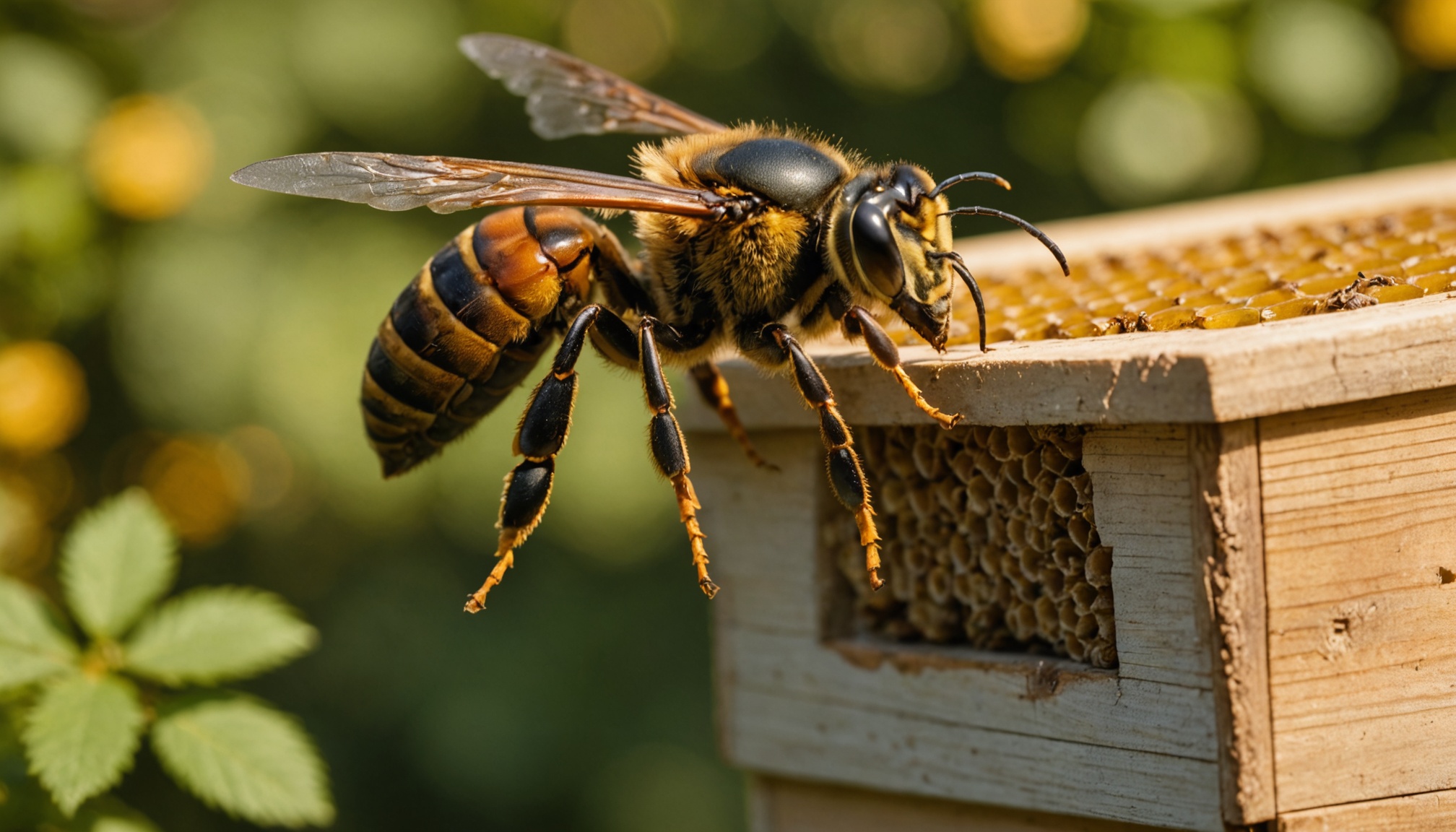
A national plan to fight the yellow-legged Asian hornet has been officially adopted in France through an interministerial order published on Wednesday, September 16, 2026, in the Official Journal. The order, signed by Minister of Agriculture Annie Genevard and Minister Delegate for Ecological Transition Mathieu Lefèvre, aims to better coordinate surveillance, trapping, and nest destruction nationwide for this invasive species, which threatens bee colonies and the French beekeeping industry.
A Species Established for Over Twenty Years
The yellow-legged Asian hornet (Vespa velutina nigrithorax) is an invasive exotic species native to Southeast Asia. Accidentally introduced into France in 2004 in the Lot-et-Garonne department, the insect has since colonized all mainland French departments. A major predator of hymenopterans, it particularly targets honeybees, intercepting worker bees directly in front of hives, weakening colonies already strained by other health pressures.
It is not the only hornet species worrying authorities: the oriental hornet (Vespa orientalis), first detected in France in Marseille in 2021, is also continuing to establish itself in the southeast of the country, with several nests spotted and destroyed in recent years. However, the new national plan focuses on the most widespread and best-documented species, the yellow-legged hornet.
What the National Plan Provides
Mandated by the law of March 14, 2025, aimed at curbing the spread of the Asian hornet and protecting the beekeeping industry, the plan's stated goal is to “strengthen and coordinate the fight nationwide.” Its operational implementation must now mobilize several levels: state services, local authorities, beekeeping health defense groups, and private individuals, who are called on to report nests spotted on their property.
- A common framework for monitoring and reporting nests across mainland France
- Strengthened coordination between public actors and beekeepers to organize trapping and destruction
- A regulatory anchor, via interministerial order, intended to give national scope to initiatives that had until now been mostly local or departmental
This formalization comes after several years of mobilization by the beekeeping sector, which has regularly faced colony losses attributed in part to pressure from the Asian hornet, in addition to other factors such as the varroa mite or pesticides.
Why This Regulation Also Concerns the General Public
Beyond beekeepers, the fight against the Asian hornet concerns all residents of affected areas: nests, often located high up in trees but sometimes also in cavities in buildings, must be reported and then destroyed by authorized professionals—never by private individuals, due to the risk of stings. Strengthened territorial coordination is meant to make it easier to identify approved professionals and handle reports, a point local officials dealing with residents' requests have often flagged as a bottleneck.
More broadly, this plan reflects a growing concern for protecting biodiversity and native species from invasive exotic species, whether in wildlife, as recent protected-species listings such as the rock ptarmigan and the western capercaillie remind us, or the return of species like the European otter to French rivers. Find more news on French wildlife in our Animals section.
For now, authorities have not released a detailed rollout timeline or a specific budget for the plan. The upcoming spring trapping campaigns, when founding queens emerge from hibernation, will serve as a first real-world test of this strengthened coordination. Infosoir's wildlife and biodiversity section will continue following this story.
Frequently Asked Questions
Is the Asian hornet dangerous to humans?
Like other hymenopterans, its sting can be painful and cause an allergic reaction in sensitive individuals, particularly in cases of multiple stings near a disturbed nest. This is why nest destruction should be left to equipped professionals and never attempted by private individuals.
What should you do if you spot an Asian hornet nest?
It is recommended not to approach it or attempt to destroy it yourself, and to report its location to local authorities or a beekeeping health defense group, who will direct you to an authorized pest control company.
Will the national plan eliminate the Asian hornet?
No: the species is now considered permanently established on the mainland. The plan's stated goal is to better coordinate surveillance and nest destruction to limit its impact on bee colonies, rather than to eradicate the species.
Sources
This article was written with the help of artificial intelligence. Editorial policy
