
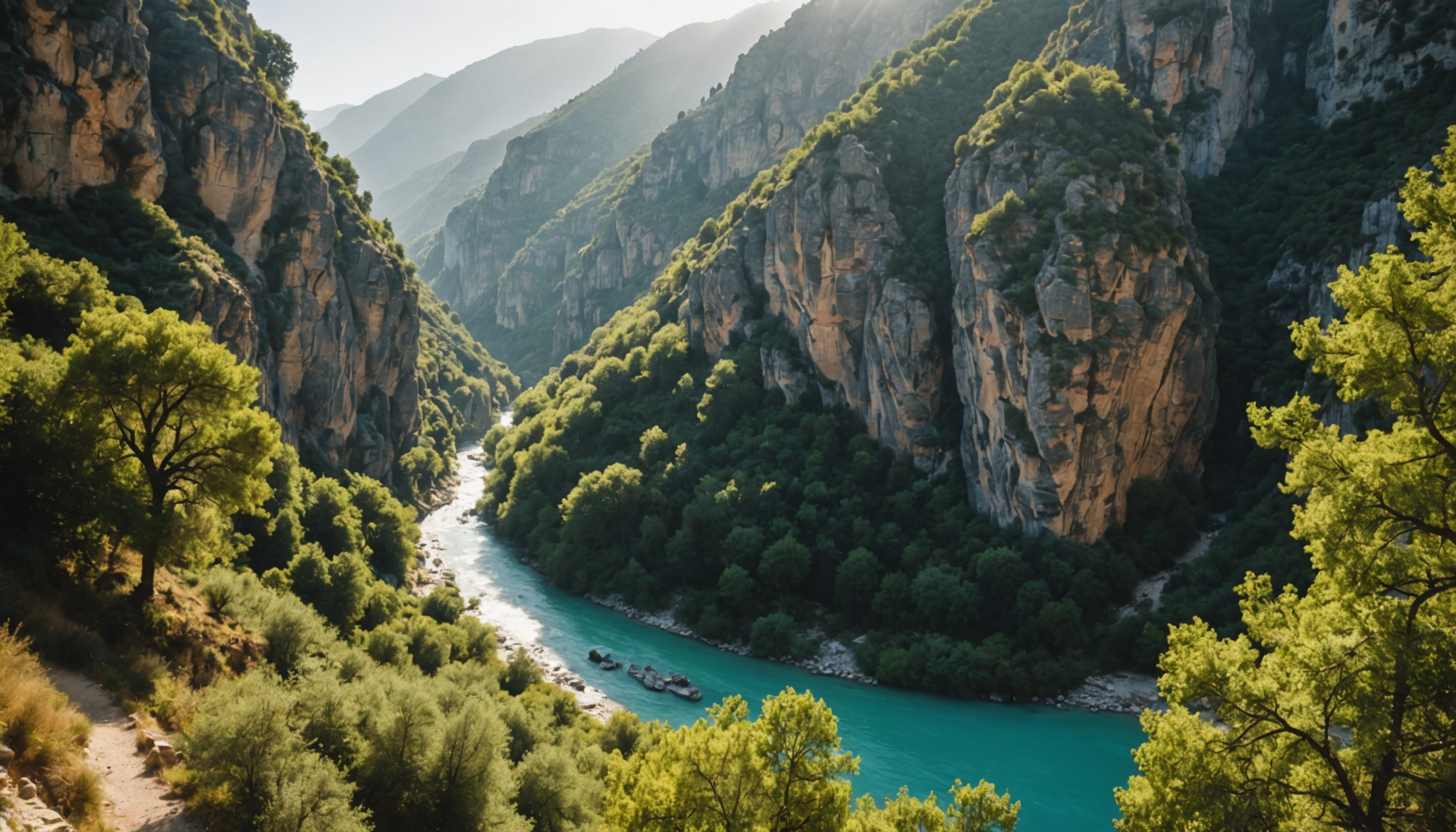
In the heart of the Peloponnese, in Arcadia, a canyon some fifteen kilometers long concentrates everything that mainland Greece has to offer that is most spectacular: an emerald river, limestone cliffs, forests of oak and chestnut trees, and a string of monasteries perched above the void. The Lousios Gorge, nicknamed “the Mount Athos of the Peloponnese,” stands out as one of the most sought-after nature and heritage getaways in this mountainous region, still largely untouched by mass tourism.
Located between the villages of Dimitsana and Karytaina, the Lousios River winds through a narrow gorge that hikers traverse in spring as well as in fall. According to the tradition reported by the ancient geographer Pausanias, the river owes its name to the bath (louô, “to wash” in ancient Greek) that the nymphs gave to the newborn Zeus. Arcadia, the mythical land of the god Pan, thus preserves a pastoral and sacred imagination that the trails reveal at every turn.
A Natural Sanctuary Classified as a “High Ecological Protection” Site
The site, classified as an archaeological zone and a high ecological protection area, is home to remarkable biodiversity. The slopes of the gorge alternate between plane trees, broom, and holm oaks, while the river, fed by springs from Mount Mainalon, stays cool even at the height of summer. The gorge measures about 15 kilometers from north to south and 2 kilometers wide at its widest point.
Hikers largely follow the so-called Mainalon Trail, which in 2015 became the first Greek route certified as a “Leading Quality Trail” by the European Ramblers Association. Over 75 kilometers, this path crosses stone villages, medieval bridges, and viewpoints that plunge into the gorge. Hiking the full route takes between four and eight days, depending on pace.
A String of Byzantine Monasteries
The nickname “Mount Athos of the Peloponnese” is no exaggeration. Several Orthodox monasteries literally cling to the walls of the gorge:
- Prodromos Monastery (Saint John the Forerunner), embedded in the cliff face, overlooks the river from about 200 meters up. It is still home to a small monastic community.
- Philosophou Monastery, one of the oldest in the Peloponnese, whose first foundations date back to 963 CE.
- Aimyalon Monastery, half carved into the rock, along with Panagia Kalamiou Monastery.
- The Byzantine church of Saint Andrew in Gortys, near an ancient site dedicated to Asclepius, god of medicine.
Visiting these sites requires appropriate dress (covered shoulders and legs) and compliance with opening hours, which vary by season. Most are reached via steep trails from the villages of Dimitsana, Stemnitsa, or Elliniko.
Stone Villages, a Living Museum, and Thermal Springs
The gorge is not just about nature. Dimitsana, at 950 meters elevation, is home to the Open-Air Water Power Museum, which traces the history of water as a power source (mills, tanneries, gunpowder works). Stemnitsa, ranked among the most beautiful villages in Greece, preserves a traditional goldsmithing school. Farther south, Karytaina's 13th-century Frankish fortress rises above the Alpheios River.
How to Get There and When to Go
The Lousios Gorge is accessible from Athens in three to four hours by car via Tripoli, then Dimitsana. No rail line serves the area directly, so a car remains essential. The most pleasant times to visit run from April to June, then from mid-September to late October, when the heat subsides and the trails are neither muddy nor overheated.
Accommodations, mostly stone guesthouses, are concentrated in Dimitsana and Stemnitsa. Several local operators offer guided hikes, river rafting on the Lousios in spring, and mountain bike descents.
Official Sources
- Discover Greece — Greek National Tourism Office: Menalon & Lousios Gorge
- Visit Peloponnese: Hiking in the Lousios Gorge
- Wikipedia Encyclopedia: Loúsios
This article was written with the help of artificial intelligence. Editorial policy