
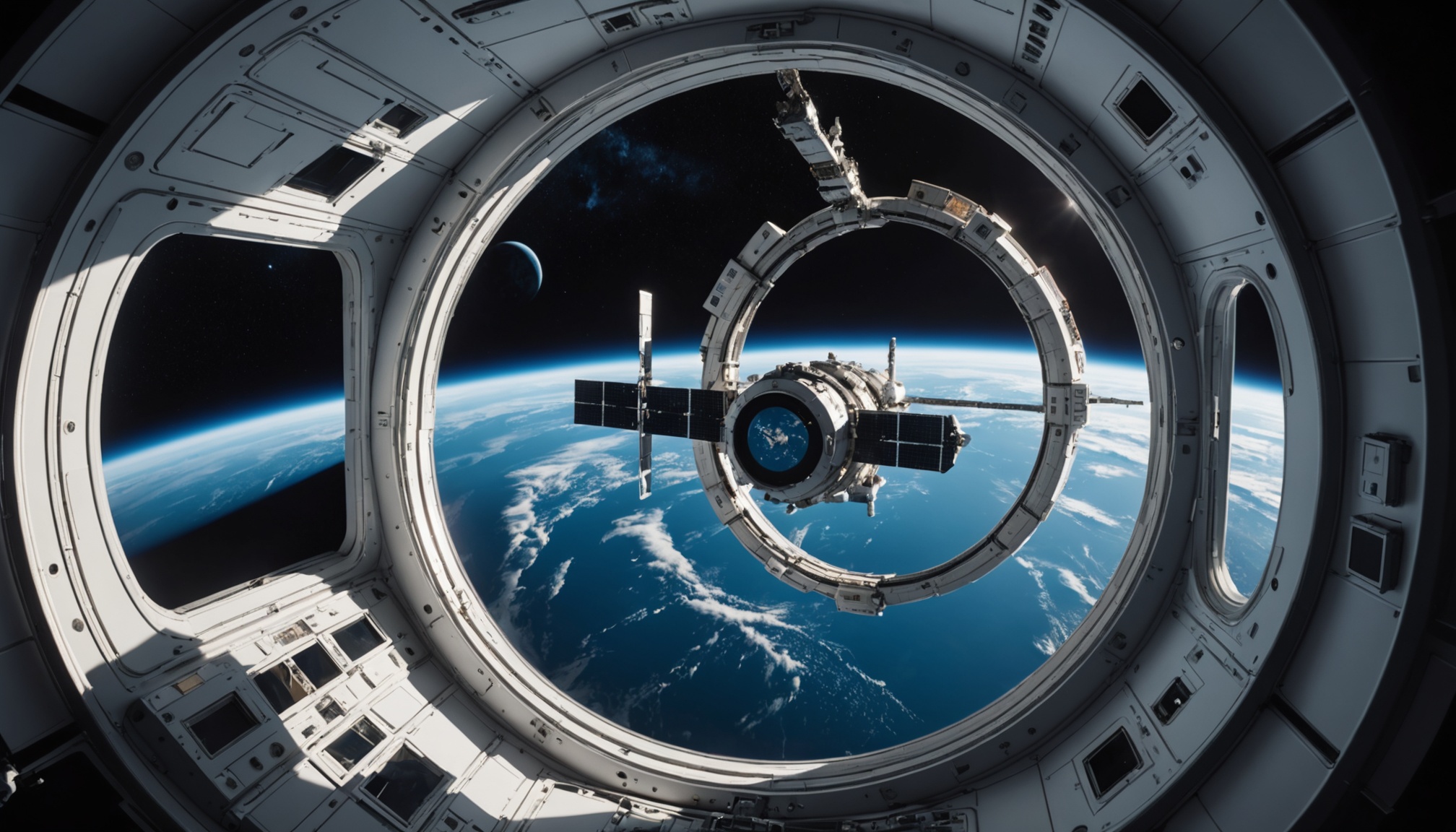
The date is now etched into the space industry's roadmap: the private space station Haven-1, designed by California startup Vast, is set to reach low Earth orbit in the first quarter of 2027. Unveiled in detail in recent days, the module promises to usher in an era in which the occupation of space will no longer rest solely with government agencies, but will also open up to commercial operators.
A Compact but Livable Module
With 45 cubic meters of living space, Haven-1 will offer a volume comparable to that of a bus, enough to house a crew of four astronauts. The manufacturer has paid close attention to the layout: four individual cabins, common areas for meals, storage dedicated to scientific experiments, and inflatable beds designed for weightlessness. The centerpiece of the design is a large dome-shaped window, about 1.1 meters in diameter, which will offer a panoramic view of Earth.
In terms of figures, the launch mass should be close to 14 tons, making Haven-1 the heaviest spacecraft ever placed into orbit by a SpaceX Falcon 9 rocket. The station is designed for a three-year service life: a deliberately short timeline that fits Vast's strategy, which aims to roll out increasingly larger platforms over the course of the decade.
SpaceX as the Exclusive Carrier
To reach orbit, Vast is relying on close cooperation with SpaceX. The Falcon 9 will carry Haven-1 from Florida, while crew rotations will take place aboard the Crew Dragon capsule, already proven on missions to the International Space Station. The first crewed mission, named Vast-1, is set to carry four astronauts for a stay of about thirty days, followed by other expeditions averaging two weeks.
The onboard scientific program will focus on biomedical research, plant growth in microgravity, and protein crystallization, a promising field for the development of future medications. Industrial technology demonstrations will round out the agenda.
A Clear French and European Dimension
Announced by Vast as part of an agreement signed with France, the presence of a French astronaut on board is one of the most talked-about new developments. Arnaud Prost will travel to Haven-1 in 2027, while Thomas Pesquet will join the International Space Station on a separate mission the same year. The United Kingdom, for its part, has sealed an agreement to send astronaut John McFall, which would mark a historic first for inclusion aboard an orbital station.
This international openness is far from a side note: it allows national agencies to access an orbital laboratory without relying exclusively on the ISS (International Space Station), which is scheduled to be decommissioned around 2030. For European space industry players, Haven-1 also represents a testing ground for crewed flight equipment.
A Milestone in the Race for Commercial Stations
Vast is not alone in this field. Several American consortiums, backed by NASA, are also working on private stations meant to take over from the ISS. The California-based company, however, intends to stay ahead thanks to its tight timeline and self-funding strategy. Its roadmap already includes a larger-capacity station, named Haven-2, starting in 2028.
- Planned launch: first quarter of 2027 from Florida
- Livable volume: 45 m³ for four astronauts
- Orbital service life: three years
- Transport: Falcon 9 (launch) and Crew Dragon (crews)
Several technical milestones still need to be cleared before liftoff: completion of systems integration, qualification of life-support equipment, and certification of the inaugural mission by U.S. authorities. Vast has stated that the module's primary structure has been finalized, putting the company on track to meet its 2027 target.
Official Sources
- Vast — Official Haven-1 Page
- Vast — Announcement of the Haven-1 and Vast-1 Missions
- Wikipedia — Haven-1 Entry
This article was written with the help of artificial intelligence. Editorial policy