
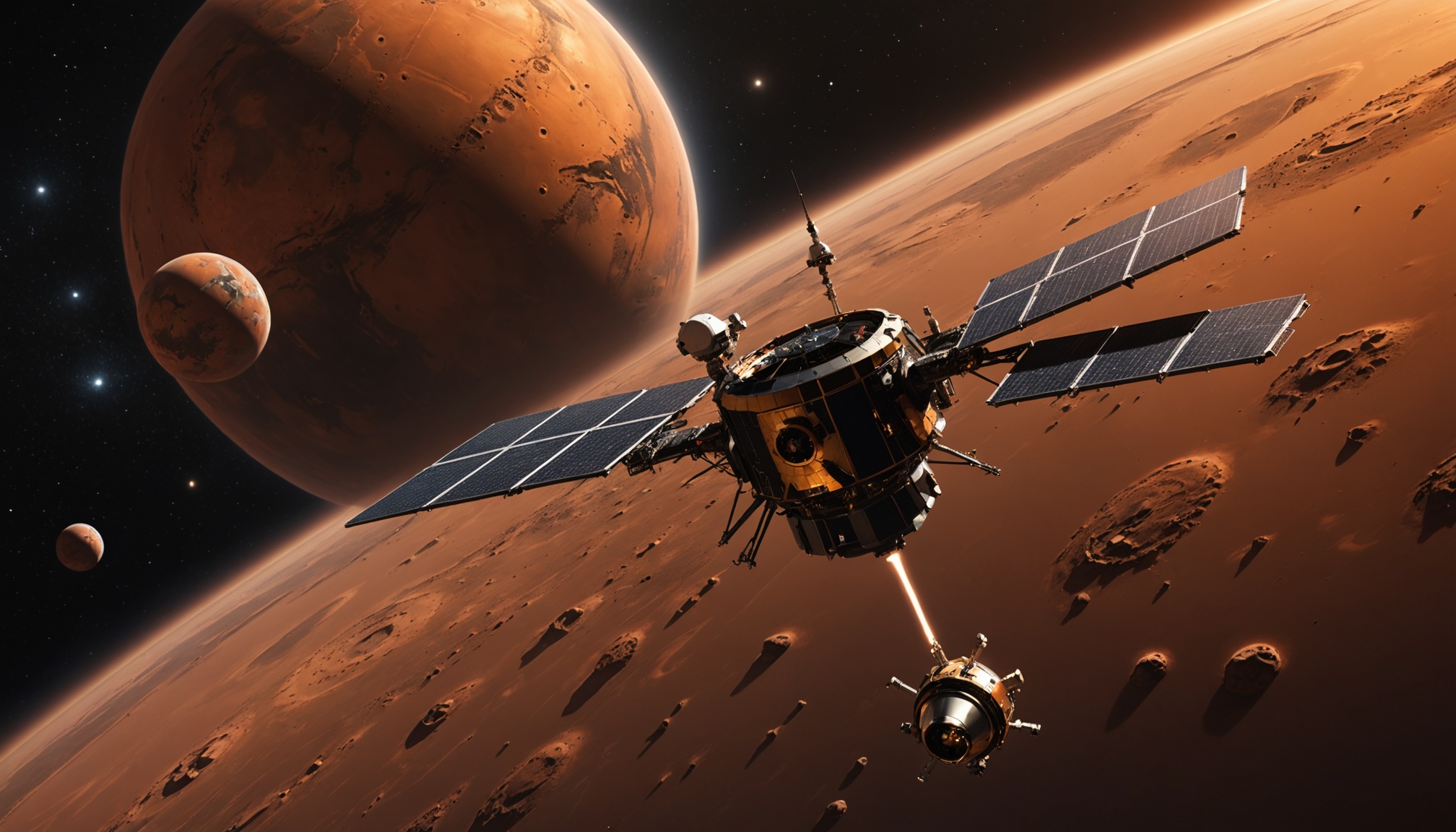
NASA's Psyche probe has reached a decisive milestone in its interplanetary journey. On May 15, 2026, the spacecraft carried out its closest flyby of Mars, using the Red Planet's gravity to gain the speed it needs for the rest of its mission. Its destination: a mysterious metal-rich asteroid located in the main belt, between Mars and Jupiter.
A Lightning Pass 4,609 Kilometers from Mars
The maneuver, monitored from NASA's Jet Propulsion Laboratory mission control center, was carried out with surgical precision. The probe skimmed past the Martian surface at an altitude of just 4,609 kilometers, traveling at a dizzying speed of nearly 19,850 kilometers per hour relative to Mars. At that distance, the planet loomed large in the spacecraft's sensors, though Psyche had only a few hours to make the most of the encounter.
This type of flyby, known as a gravity assist, is a classic technique for solar system missions. By passing close to a massive body, a spacecraft can alter its trajectory and accelerate without burning a drop of fuel. For Psyche, the gain is substantial: roughly an additional 2 km/s relative to the Sun, along with a shift of about 1 degree in its orbital plane. Without this assist, reaching the target asteroid would have required far more onboard propellant.
A Full-Scale Test of the Science Instruments
The close pass by Mars was also used to calibrate the spacecraft's instruments. Psyche's multispectral imager captured thousands of observations of the planet, including images showing Mars as a thin, luminous crescent. These images help scientists study how the Martian atmosphere and its fine dust scatter sunlight—an excellent exercise for fine-tuning the cameras ahead of the mission's main rendezvous.
The science team also tested its pointing, data transmission, and processing procedures—operations that will need to be flawlessly executed once the probe reaches its true target, hundreds of millions of kilometers from Earth.
Destination: Asteroid 16 Psyche, a Metallic World
The probe is now continuing on its way to asteroid 16 Psyche, an object roughly 280 kilometers across at its widest point, orbiting the Sun between Mars and Jupiter. This celestial body has fascinated researchers for decades because of its highly unusual composition: it may be largely metallic, rich in iron and nickel, unlike most known asteroids, which tend to be rocky or icy.
According to NASA's leading hypothesis, 16 Psyche could be the exposed core of an embryonic planet—a planetesimal that never fully formed, whose outer layers were stripped away by violent collisions in the early days of the solar system. Studying it up close would, in a sense, be like directly observing what lies hidden at the heart of rocky planets, including our own, without having to drill thousands of kilometers beneath our feet.
Arrival Expected in 2029
Launched in October 2023 from Florida aboard a Falcon Heavy rocket, the Psyche mission is one of the most ambitious in NASA's Discovery program. After this Mars flyby, the probe is now entering the longest leg of its journey. Its orbital insertion around the asteroid is expected in 2029, after covering a total distance of more than four billion kilometers.
Once there, Psyche will spend roughly two years near its target, mapping it, measuring its gravitational and magnetic fields, and analyzing its composition using dedicated instruments. The data collected should provide valuable insight into how rocky planets form, and why some of them never managed to fully develop.
Official Sources
- NASA – Psyche Mission Aces Mars Flyby, Targets Metal-Rich Asteroid
- NASA / JPL – Official Statement on the Flyby
- NASA Science – Overview of the Gravity Assist
This article was written with the help of artificial intelligence. Editorial policy