
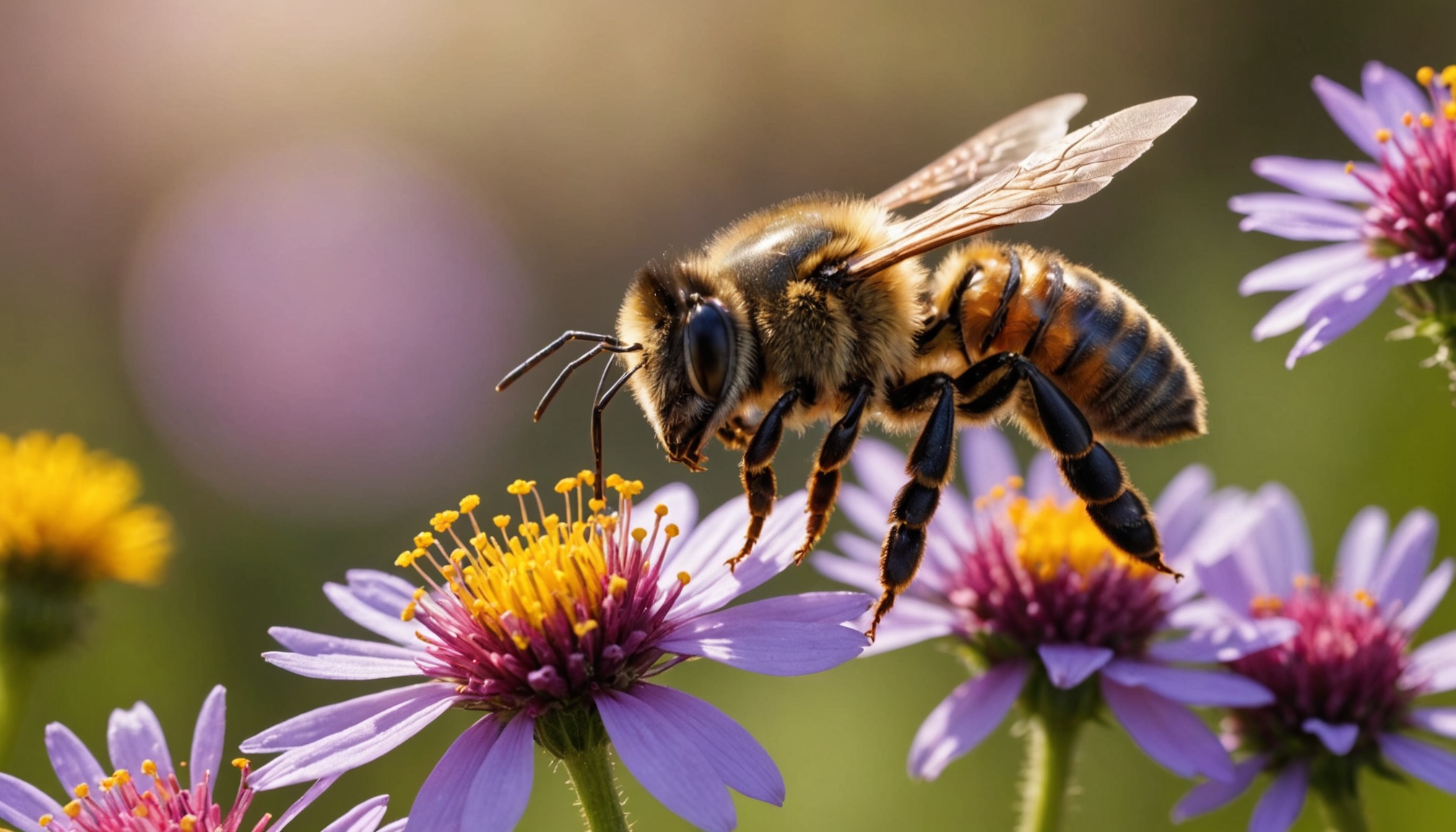
A study published in the journal Science Advances in July 2026 is shaking up what we thought we knew about how pollinating insects find their way. Out of 96 bee species tested, 74 contain magnetic particles that could serve as an internal compass — a far larger proportion than scientists had previously expected.
A Compass Hidden in the Abdomen
The researchers worked from dried specimens belonging to the Apidae family, which includes honey bees as well as many solitary species. By grinding these insects into a powder and measuring their magnetism with a magnetometer, the team detected the presence of magnetite, an iron-based compound already known in other migratory animals such as certain birds and sea turtles. Notably, these particles are not concentrated in a single area of the body, which forces researchers to reconsider several widely held assumptions about how this “compass” actually works.
What This Actually Changes
Until now, research into bee orientation had focused almost exclusively on vision and scent cues. This discovery suggests that magnetoreception may play a complementary role, particularly for short-distance navigation — a mechanism that appears to have persisted for nearly 150 million years of evolution in these insects. Additional research published in May 2026 points in the same direction: it found magnetic sensitivity in nearly 90% of the 120 bee species studied, as well as in numerous wasp species, suggesting that this sense may be far more widespread and ancient among hymenopterans than previously thought.
Questions That Remain Open
The study's authors remain cautious: the presence of magnetite alone does not prove that bees actively use it to navigate. However, earlier experiments showed that artificially magnetizing the abdomen of a live honey bee disrupts its ability to navigate within its local environment — a strong clue, but not definitive proof of the exact mechanism involved. Scientists still do not know precisely when this sense comes into play, or why it has persisted for so long across such a diverse range of species.
This line of research could eventually help explain the decline of certain pollinators, at a time when preserving wildlife remains a major concern: in Ecuador, the recent discovery of 69 mammal species in an ecological corridor is a reminder of just how poorly documented biodiversity still is. In the depths of the Pacific, the 24 newly discovered amphipod species illustrate the same trend. Targeted conservation efforts sometimes pay off, as shown by the comeback of the black rhino in Zimbabwe's parks.
Frequently Asked Questions
Do all bees have this magnetic compass?
No. Of the 96 species tested in the July 2026 study, 74 had detectable magnetic particles — a large majority, but not every single species.
Are bees the only insects affected by this phenomenon?
No. Research published in May 2026 also detected magnetic sensitivity in numerous wasp species, suggesting that this sense is shared more broadly among hymenopterans.
Is this discovery definitive proof of how the navigation mechanism works?
Not yet. The presence of magnetite is strong evidence, reinforced by disruption experiments, but researchers have not yet established with certainty how and when this magnetic sense comes into play during bees' movements.
Sources
- The Conversation — Many bee species contain magnetic particles
- Physics World — Honey bees navigate using magnetic abdomens
- Phys.org — Bee magnetism appears far more widespread than expected
This article was written with the help of artificial intelligence. Editorial policy