
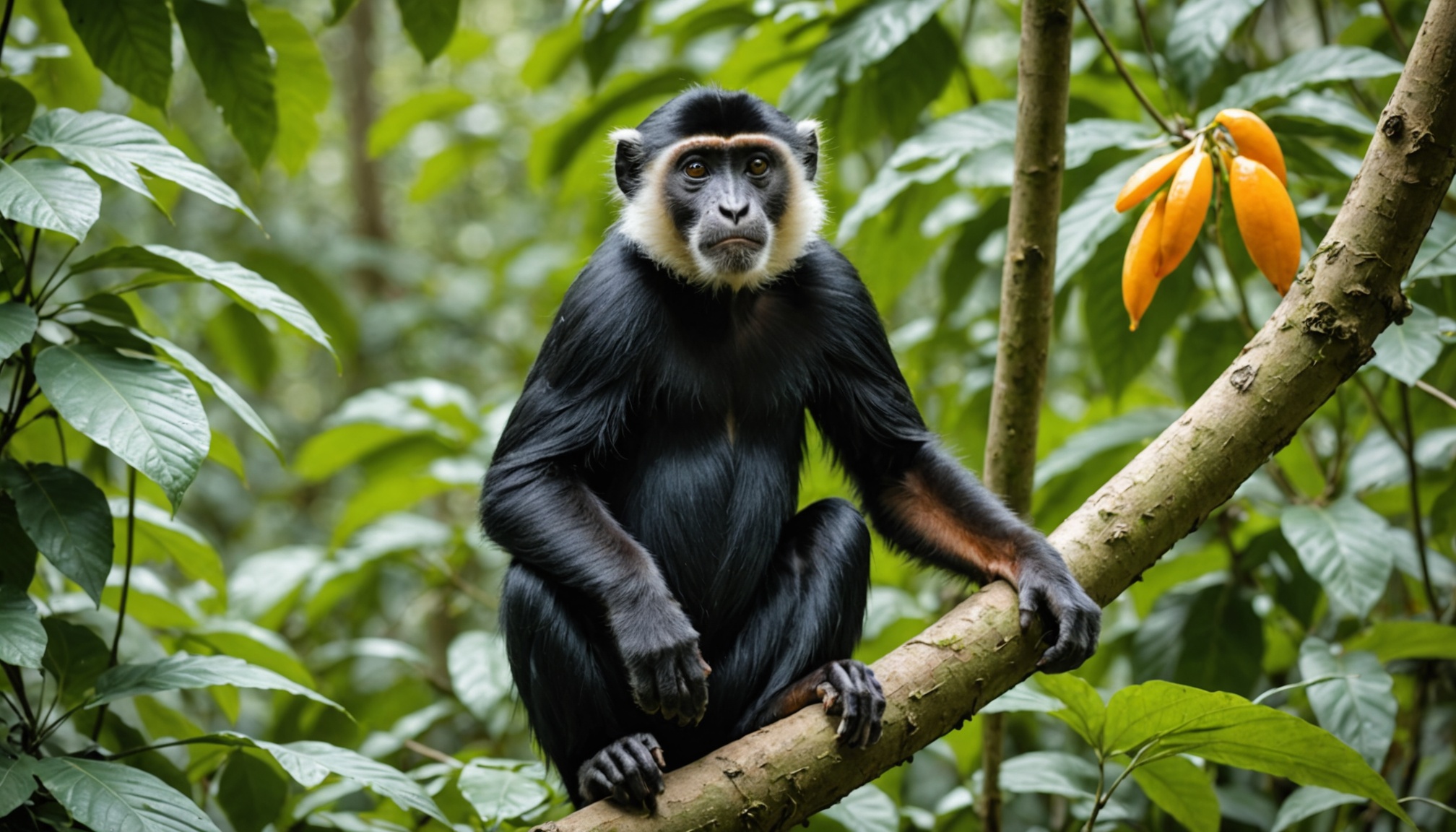
Even in 2026, it still happens that a large mammal completely escapes the notice of science. That is the case of the Likweli, an orange-muzzled monkey that has just been officially described in the remote forests of the Democratic Republic of the Congo (DRC). Its discovery, published on July 15 in the journal PLOS One, is a reminder of just how unexplored tropical biodiversity remains — and how it can disappear before it even has a name.
A Primate That Remained Unseen for Decades
Scientifically named Colobus congoensis, the animal is a small colobus monkey with an almost entirely black coat, recognizable by a cream-and-orange patch around its mouth and a white marking under its tail. It lives high in the canopy of Lomami National Park, in a dense forest area wedged between the Lomami and Congo rivers, in the eastern part of the Congo Basin.
The story of its recognition begins in 2008, when researchers photographed a monkey half-hidden in the foliage but were unable to identify it. It would take a long observation campaign, between 2018 and 2022, to gather enough evidence: 114 detections in total, combining photographs, direct sightings, and recordings of its deep, raspy call. Its range is estimated at only about 1,700 square kilometers.
The Fifth African Primate Species in 75 Years
What makes the Likweli exceptional is not just its appearance: it's its statistical rarity. The authors point out that it is only the fifth African primate species described from a previously unknown population in 75 years. Yet monkeys are among the most studied animals in the world, which makes each new description all the more remarkable.
The contrast is striking compared with insects or microorganisms, of which thousands of new species are discovered every year. Finding a mammal of this size still unknown to modern science is a rare exception, and it says a great deal about how inaccessible certain forests of Central Africa remain, where human and scientific presence is still scarce.
Discovered, but Already Endangered
The paradox is a cruel one: scientists are already proposing to classify the Likweli among endangered species. Several factors justify this early warning:
- A tiny range: in such a restricted territory, even a minor local disturbance can threaten the entire population.
- A small population, still poorly assessed but clearly fragile.
- Hunting pressure, which weighs on many primates in the region.
- Habitat loss: at least 15 new villages have appeared in or near its range between 2015 and 2023.
Describing a species while immediately recommending its protection is becoming an increasingly common situation. Naming an animal also makes it visible to conservation policy: without an official status, it is difficult to justify protecting a territory or mobilizing funding.
Why This Discovery Matters for Everyone
Beyond the naturalist's anecdote, the Likweli illustrates a global issue. Tropical forests hold an immense share of life on Earth, much of it still to be documented. Modern tools — bioacoustics, camera traps, environmental DNA analysis — now make it possible to identify species that had until now escaped human notice. But this race against time is playing out against a backdrop of deforestation and expanding human activity.
For the general public, the Likweli's story is also a useful reminder: distant nature, which we assume has been entirely mapped, still holds surprises. Protecting these areas means preserving a living heritage whose very existence often goes unrecognized.
Frequently Asked Questions
What Is the Likweli?
The Likweli (Colobus congoensis) is a species of colobus monkey recently described in the Democratic Republic of the Congo. It is distinguished by its black coat and an orange patch around its mouth. Its common name comes from the local term.
Where Does This New Species Live?
It lives in the canopy of Lomami National Park, between the Lomami and Congo rivers, in an isolated forest region of the Congo Basin, in eastern DRC.
Why Is It Already Considered Endangered?
Its very limited range, its small population, hunting, and habitat loss have led researchers to propose classifying it as an “endangered” species right from its scientific description.
Sources
- La Presse — New monkey species filmed in the rainforest
- Science (AAAS) — Mysterious orange-lipped monkey discovered in the Congo rainforest
- Frankfurt Zoological Society — Striking new species of African monkey discovered
This article was written with the help of artificial intelligence. Editorial policy