
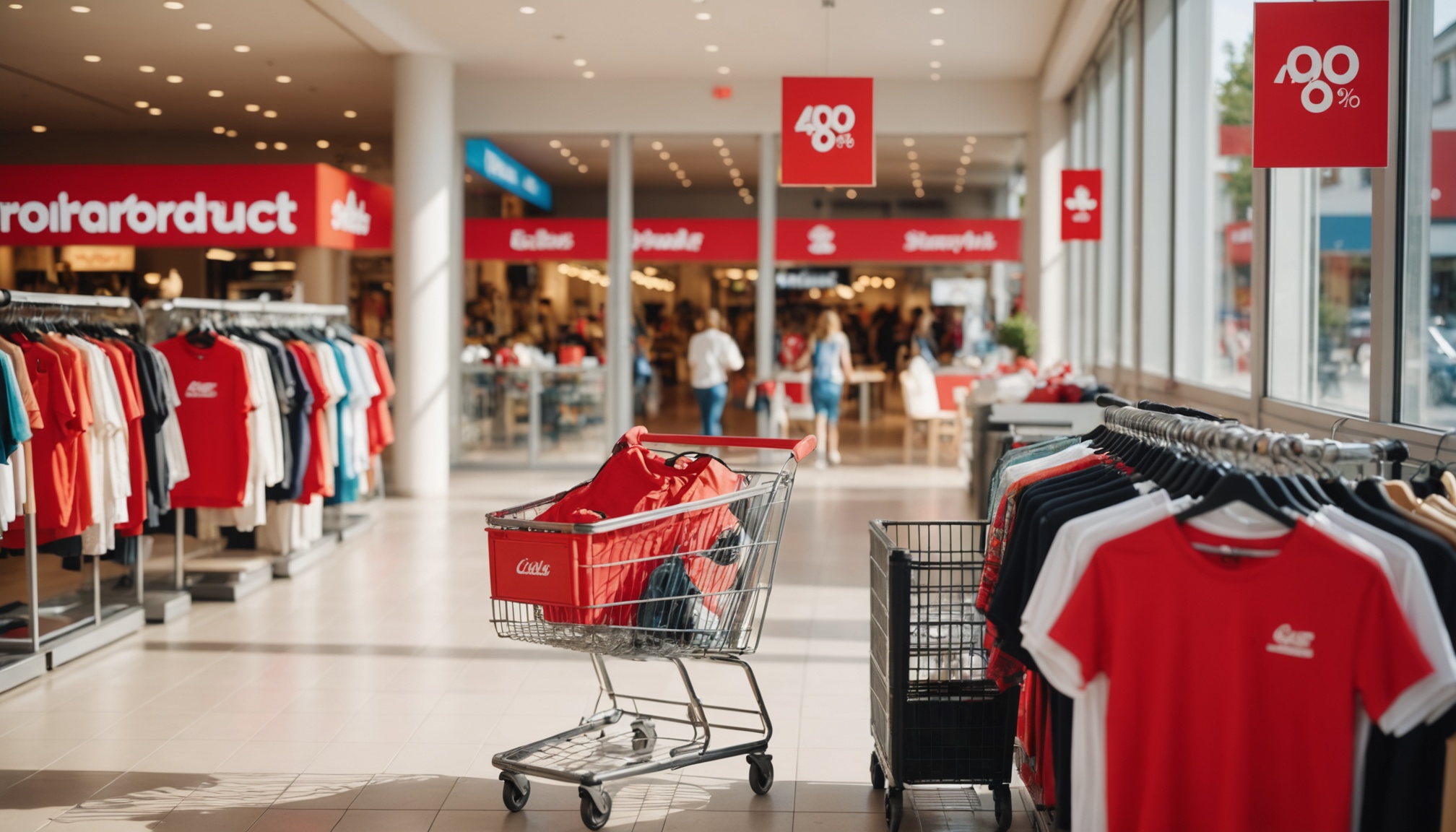
The 2026 summer sales began on June 24 in France and run through July 21, inclusive. Four weeks of markdowns arriving amid a distinctive economic backdrop: pressured purchasing power, an early heat wave, a decline in textiles, but also an average budget that consumers report is sharply higher. Behind the usual retail routine, the 2026 edition marks something bigger: for the first time in a long while, fashion is no longer calling the shots.
Calendar and key figures for the 2026 summer sales
The official dates set by the General Directorate for Competition, Consumer Affairs, and Fraud Control (DGCCRF) are the same across mainland France, except in Corsica, where the sales run from July 8 to August 4. Online retailers follow the national calendar, regardless of where the brand's headquarters are located.
According to an OpinionWay survey conducted for the payment platform Mollie in June 2026, 39% of French people plan to take advantage of this sales period, a figure that has held steady for three years. The real signal lies elsewhere: the average reported budget reaches 357 euros, 124 euros more than in 2025. More than half of respondents (55%) even plan to spend over 200 euros. A breath of fresh air for retailers, in a spring marked by inflation reignited since the conflict that broke out in the Middle East in late February 2026.
The historic shift on store shelves: appliances overtake fashion
This is the big surprise of this edition. Appliances account for nearly 30% of sales by value, ahead of footwear (12%) and clothing, which now makes up just 7%, according to data collected by retailers and compiled by the trade press. The exceptional June 2026 heat wave, with peaks above 40°C in several départements, sent demand soaring for fans, portable air conditioners, air circulators, and replacement refrigerators.
Fashion, meanwhile, is dealing with a pileup of difficulties. Clothing and textile sales had already fallen 3.7% year-over-year in March 2026, after a 2.3% decline between September and December 2025. Households are postponing purchases deemed non-essential, and budget trade-offs are now being made between keeping the home cool and building a summer wardrobe.
The quiet comeback of brick-and-mortar stores
Another shift: physical stores are gaining ground over screens. 48% of sale shoppers say they buy exclusively in stores, up 4 points in a year. The trend is especially pronounced among young adults: 52% of 18-24-year-olds favor physical stores (+10 points), followed by 45% of 25-35-year-olds. Conversely, the hybrid online-plus-store path is down 6 points, to 29%, while “all-online” shopping remains stable at 23%.
This shift comes with a clear dose of caution: 89% of consumers surveyed say they will turn to brands they already know. The instinct for safety outweighs the hunt for unfamiliar bargains.
What researchers say about retailers' strategies
Sales pose a largely invisible dilemma on the retailer's side: should they maximize margin or clear inventory? A recent study by Arvind Sainathan (Neoma Business School) and Fang Liu (Durham University), published on The Conversation, shows that two financially equivalent promotions don't produce the same effect at all. A simple price cut lowers the perceived unit cost, whereas a “buy one, get one free” offer imposes a minimum purchase threshold and can discourage smaller baskets.
The researchers conclude that the right lever depends on two factors: stock level and product type. Low stock plus heterogeneous products (clothing, accessories): classic discounts. Full stock plus homogeneous products (toothpaste, detergent, identical small appliances): bundled offers. A useful framework for understanding why one aisle displays a straight 50% off while the next one offers a bundled basket.
Practical tips for shoppers
- Compare the reference price on neutral websites before heading into the store: the advertised discount must be calculated against the lowest price charged in the 30 days before the sales began.
- Favor retailers where the return policy still applies during the sales: the law makes no distinction between a sale item and a full-price item when it comes to defects.
- Save the “major appliance” budget for the second markdown wave, usually more generous, but accept the risk that the most sought-after items may sell out.
- Draw the line between useful purchases and impulse buys: 89% of sale shoppers target a familiar brand, but that's also where baskets tend to grow beyond what's needed.
Frequently asked questions
What are the exact dates of the 2026 summer sales in France?
From Wednesday, June 24, 2026, at 8 a.m. through Tuesday, July 21, 2026, inclusive, for mainland France. Corsica is an exception, with a period running from July 8 to August 4, 2026.
Is the announced average budget of €357 representative?
It comes from an OpinionWay survey for Mollie conducted in June 2026. It's a reported budget, meaning an intention, more optimistic than the spending actually recorded at checkout. Still, the €124 increase compared to 2025 remains a strong signal of renewed appetite.
Why do appliances outweigh fashion this year?
Because the early heat wave in June 2026 triggered emergency purchases of cooling appliances, while textiles have already been in a structural decline since 2025. Appliances account for nearly 30% of sales by value, compared to 7% for clothing.
Sources
- Économie.gouv.fr — Official dates of the 2026 summer sales
- The Conversation — Sainathan & Liu, promotional strategies
- LSA — How the heat wave is upending the 2026 summer sales
This article was written with the help of artificial intelligence. Editorial policy
