
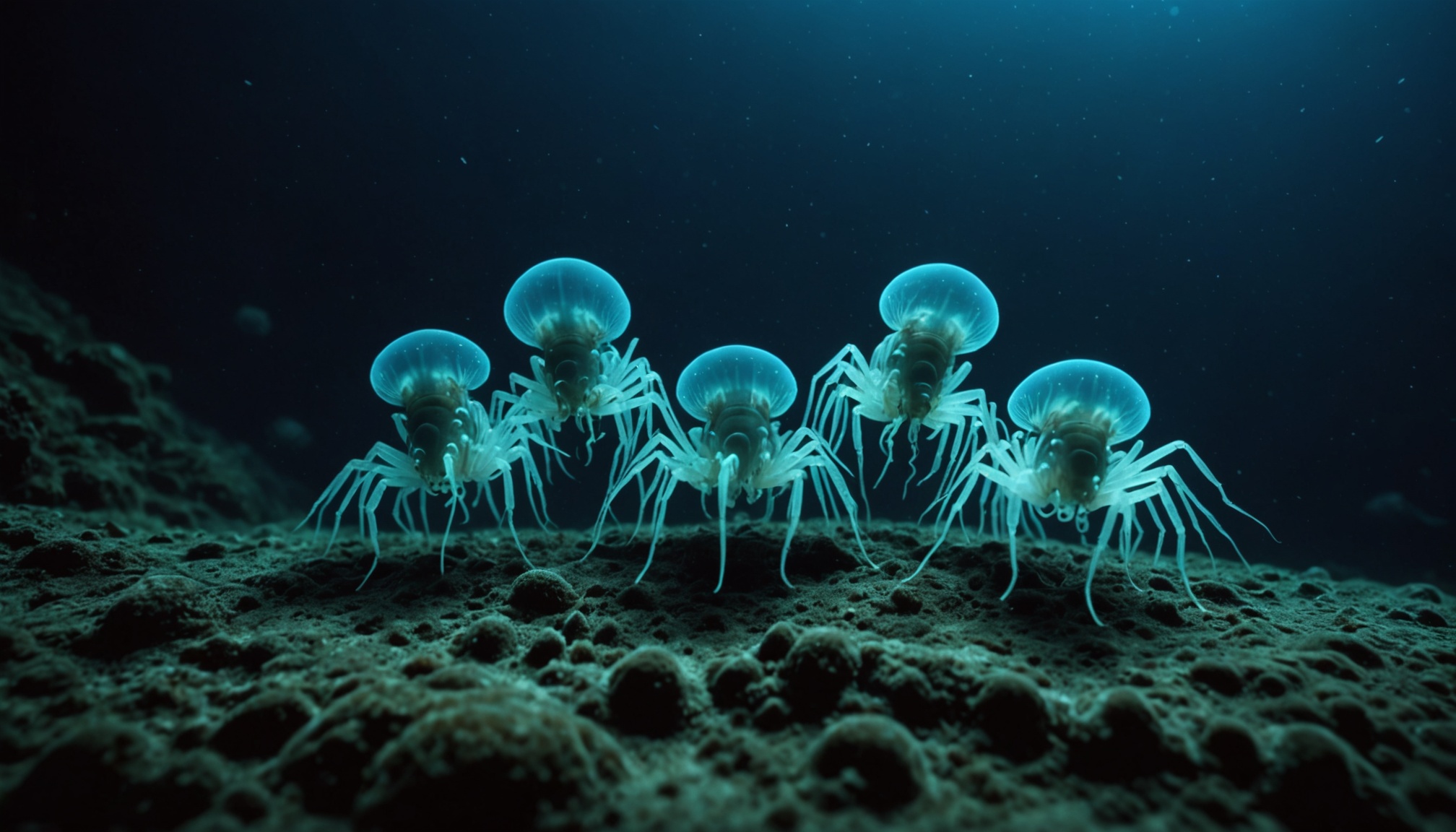
More than 4,000 meters deep, in a Pacific abyssal plain six times the size of France, researchers have just described 24 new species of amphipods, small crustaceans previously unknown to science. The discovery is reigniting debate over the preservation of these ecosystems, which are coveted for their mineral resources.
An Abyssal Plain That Remains Largely Unexplored
The area in question, known as the Clarion-Clipperton Zone, covers about six million square kilometers between Hawaii and Mexico. It was there, more than four kilometers below the surface, that samples were collected and later analyzed during a taxonomy workshop bringing together sixteen scientists at the University of Łódź in Poland in February 2024. The results of this work have just been published in the open-access journal ZooKeys.
An Entirely New Branch of Life
Most of the 24 species described measure barely a centimeter long. But the real surprise comes from one of them: it belongs to an entirely new superfamily, named Mirabestioidea, and a new family, the Mirabestiidae. These classifications represent evolutionary lineages that had gone completely unnoticed until now. Some type specimens, such as that of the species Elimedon breviclunis, are now held by the Natural History Museum in London.
- 24 new amphipod species described in a single study
- A new superfamily and a new family identified
- Samples collected as early as 2021, more than 4,000 meters deep
A Scientific… and Economic Issue
This description is part of a broader initiative by the International Seabed Authority (ISA), called “Sustainable Seabed Knowledge Initiative: One Thousand Reasons,” which aims to describe a thousand species new to science before the end of the decade. The goal is all the more urgent given that the Clarion-Clipperton Zone is also coveted by several companies for its polymetallic nodules, rich in metals used in batteries. Scientists stress how important it is to document this biodiversity before any extraction projects begin, in order to precisely measure what could be affected. This issue, closely followed by players in the global raw materials economy, illustrates the growing tension between resource exploitation and the preservation of the seafloor.
Why This Discovery Matters
Beyond the case of the Clarion-Clipperton Zone, this publication is a reminder of just how little is known about the deep ocean: scientists estimate that a considerable share of deep-sea marine biodiversity has yet to be documented. Every new exploration campaign, whether it concerns terrestrial or marine animal species, helps fill these gaps and shape decisions on ocean management. This is just the latest addition to the long list of topics covered in our news section devoted to science and the environment.
Frequently Asked Questions
What is an amphipod?
An amphipod is a small crustacean, generally ranging from a few millimeters to a few centimeters in size, found in nearly every aquatic environment, from rivers to the ocean depths.
Where is the Clarion-Clipperton Zone located?
It is a vast abyssal plain in the central Pacific, located between Hawaii and Mexico, covering about six million square kilometers at depths exceeding 4,000 meters.
Why is this area under particular scrutiny?
It holds significant deposits of polymetallic nodules, rich in metals used notably in batteries, making it a potential target for deep-sea mining, a practice still under international debate.
Sources
This article was written with the help of artificial intelligence. Editorial policy