
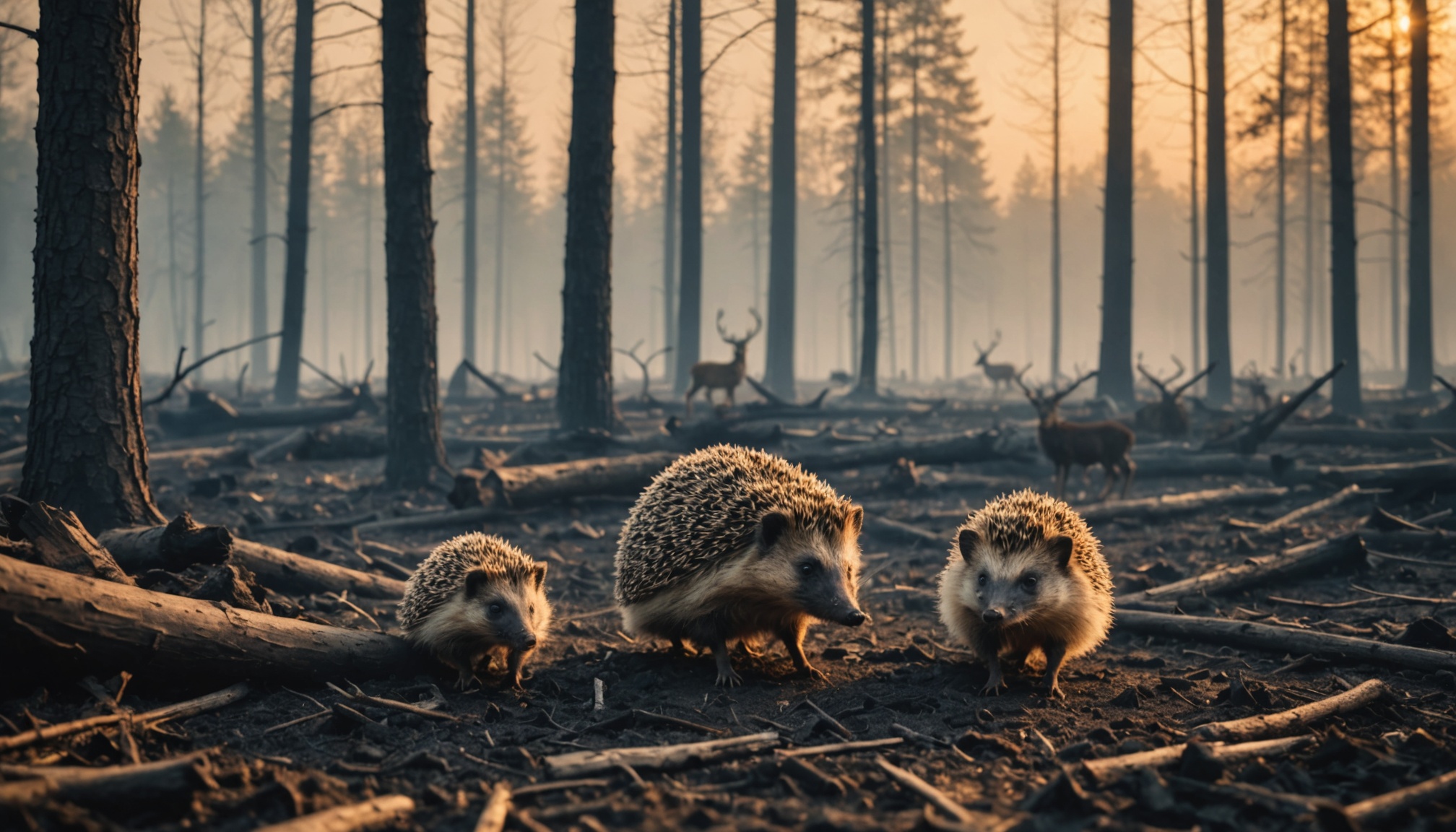
Since July 22, 2026, a massive wildfire has been ravaging the Gironde region in France: 42,000 hectares of forest have already gone up in flames and about 220,000 people have had to be evacuated, according to situation updates from French state services. Behind these staggering numbers lies another victim, often invisible: wildlife. Hedgehogs unable to flee, disoriented roe deer, reptiles and amphibians trapped by the flames… With France having already seen 115,000 hectares burn since the start of 2026 (announced by Interior Minister Laurent Nuñez in late July), protecting wild animals from fires is becoming an issue in its own right.
Protected Species on the Front Line
The area affected by the fire is home to several species with special protected status. This includes the Western spadefoot toad, a small, discreet toad measuring 7 to 11 cm, the ocellated lizard, Europe's largest lizard, which can reach 75 cm, and the greater white-toothed shrew, one of the smallest terrestrial mammals in the world. The European pond turtle, a freshwater turtle already weakened by the 2022 fires in the same area, is also directly at risk: ash and toxic residue falling into water bodies threaten its survival long after the flames are extinguished.
The most vulnerable animals aren't always the most visible ones. A hedgehog that curls into a ball instead of fleeing, a squirrel that climbs toward the treetops where the heat is most intense, or insects and amphibians with limited mobility: their usual survival strategies work against them when faced with a megafire spreading at high speed.
Rescue Centers Under Strain: The LPO Center in Audenge
When the town of Audenge, on the Arcachon Bay, had to be evacuated on July 23, the wildlife rescue center run by the LPO (Ligue pour la Protection des Oiseaux, the French bird protection league) located there also had to be emptied in an emergency. Thanks to the mobilization of staff and volunteers, about a hundred animals undergoing treatment were transferred to the rescue center in Tonneins, which agreed to take them in until the situation stabilized. This episode illustrates the extreme strain that wildlife rescue centers across mainland France have been under this summer, already stretched thin by a series of heat waves even before the fire broke out.
What to Do If You Find an Injured Wild Animal
Faced with an animal visibly affected by a fire or a heat wave, a few simple actions can help without making things worse:
- Do not approach or try to handle the animal: the stress caused by human contact can be more dangerous to it than the injury itself.
- Contact the French Office for Biodiversity (OFB), the local LPO chapter, or the nearest wildlife rescue center.
- Provide as much precise information as possible: exact location, presumed species, the animal's apparent condition (injured, burned, disoriented).
- Keep dogs and children away to avoid causing the animal any additional stress.
- Never give it food or water on your own initiative: only professionals at rescue centers know how to properly care for each species.
These steps, which apply year-round when dealing with wildlife in everyday life, take on particular importance during megafires, when local news keeps multiplying around the affected areas.
Frequently Asked Questions
Why Are Fires Particularly Dangerous for Small Animals?
Because their natural defense mechanisms (freezing, curling into a ball, climbing) are ineffective against a fire that spreads faster than they can flee, unlike large mammals such as roe deer or wild boar.
Do Fires Have Consequences After the Flames Are Out?
Yes: habitat destruction delays any reintroduction of animals, and ash or toxic residue that settles into water bodies can continue to affect aquatic species like the European pond turtle for months after the fire.
Who Should Be Contacted First If You Find an Injured Wild Animal?
The French Office for Biodiversity (OFB), the LPO, or the nearest wildlife rescue center to where the animal was found, avoiding any direct handling of the animal.
Sources
- LPO Nouvelle-Aquitaine — Fire and Wildlife: The Rescue Center Evacuated
- ICI Nouvelle-Aquitaine — What Are the Consequences for Wildlife from the Gironde Fire?
- Franceinfo — Gironde Fire: 42,000 Hectares Burned and 220,000 People Evacuated
This article was written with the help of artificial intelligence. Editorial policy
