
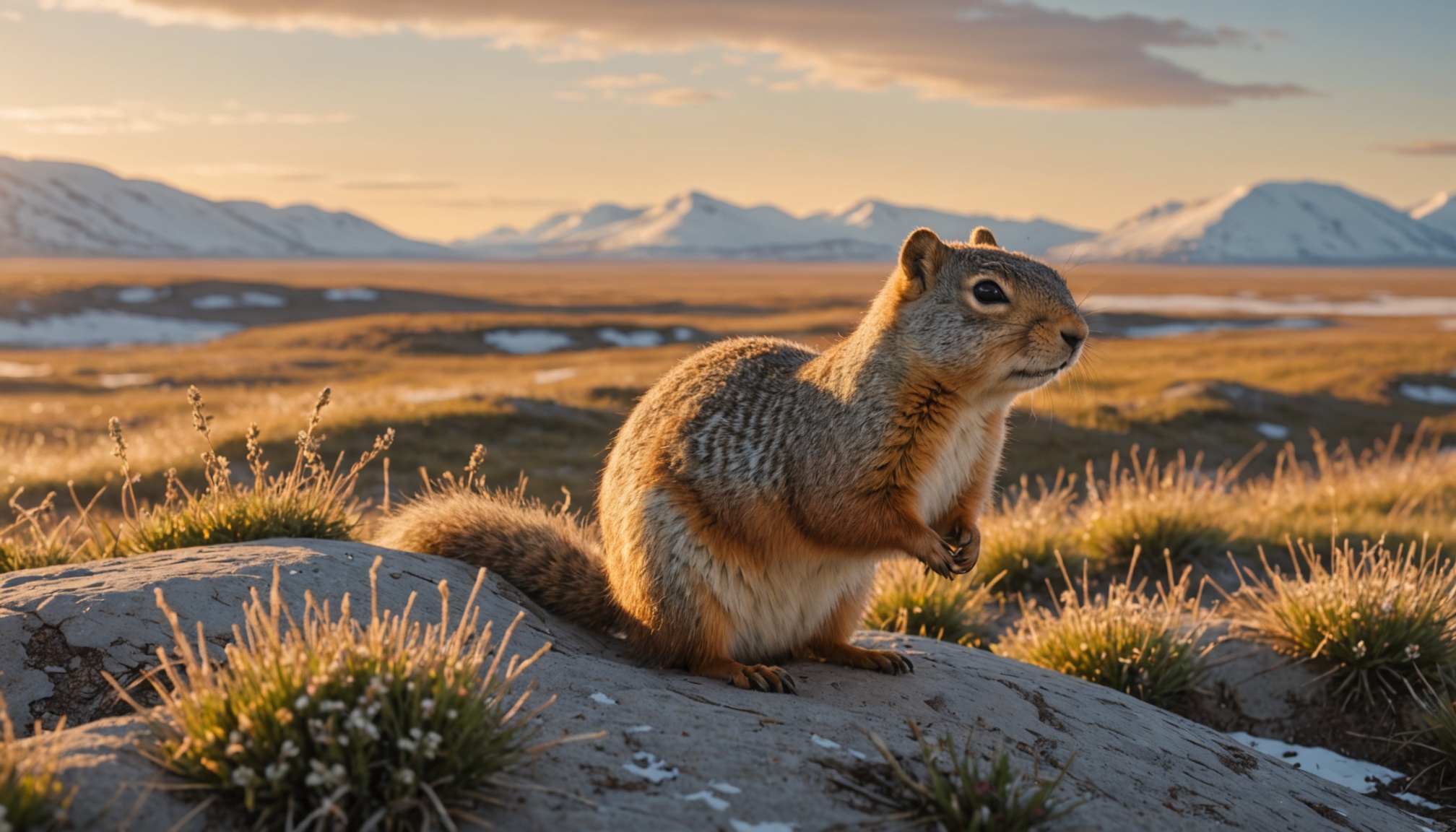
What could droppings left by squirrels, forgotten in the frozen ground of the far north for hundreds of thousands of years, possibly hide? Much more than anyone imagined. An international team has just published a study, on June 9, 2026 in the journal Nature Communications, that turns simple coprolites — in other words, fossilized droppings — into true time capsules of Arctic life from 700,000 years ago. And the contents are spectacular: DNA from woolly mammoths, steppe bison, horses, wolves, and even the genetic trace of an extinct big cat.
A discovery from the Yukon permafrost
It all started with burrows dug by Arctic ground squirrels (Urocitellus parryii) in the frozen soil of the Yukon, in Canada. For millennia, these small rodents accumulated twigs, seeds, and droppings in their underground tunnels. The permafrost — ground that stays frozen year-round — acted as a natural freezer of extraordinary precision. Nothing ever disturbed these miniature archives.
Researchers at McMaster University, who led the study, recovered coprolites from several sites dating from the Middle Pleistocene through the Holocene, spanning a range of 30,000 to roughly 700,000 years. For comparison, that places the oldest samples among the oldest DNA ever sequenced to date. It's this temporal continuity, even more than the raw age, that makes the discovery exceptional for science.
What these biological archives reveal
By analyzing the genetic material extracted from the droppings, the team reconstructed 18 complete mitochondrial genomes. These genomes come from several species that are now extinct or rare in the region:
- Woolly mammoths that lived during different glacial periods;
- Steppe bison, emblematic of eastern Beringia;
- Prehistoric horses and American hares;
- Caribou, lemmings, and gray wolves;
- A large cat, probably an American cheetah or a cougar.
Added to this are the genetic fingerprints of more than 200 plant groups, along with numerous fungi and bacteria. In short, each small burrow provided a panoramic view of the ecosystem surrounding the squirrel at the time: a landscape of cold grasslands, home to fauna often described as the “mammoth steppe.”
Why droppings preserve DNA better than bones
The most surprising aspect lies in the quality of preservation. The coprolites preserved ancient DNA better than many bones or soil samples taken nearby. Three factors combine here: the low, stable temperature of the permafrost, the confinement inside the burrow, and the biological matrix itself, which appears to protect DNA fragments against chemical degradation.
This overturns an assumption long taken for granted in paleogenetics: “noble” fossils like bones aren't necessarily the best sources of ancient DNA. More modest remains, if well preserved in a cold, dry environment, can yield more information.
What this study changes for understanding past biodiversity
Beyond the “curiosity” factor, the scientific significance is real. First, it offers a tool for reconstructing ancient ecosystems at very high resolution, species by species. Second, it allows researchers to track population dynamics of mammoths and other megafauna over long periods, without relying solely on rare, scattered skeletons. Finally, it opens the door to studying microbes and plants that classic fossils leave invisible.
For biologists tracking present-day wildlife in polar regions, this is also a valuable point of comparison. Arctic ground squirrels still inhabit the Yukon and Alaska today. Understanding the environment of their distant ancestors helps gauge what has already been lost, and what could still be lost if northern ecosystems keep warming over the long term. The topic connects, indirectly, to ongoing debates about the conservation of animals and sensitive habitats, as well as the practical, climate-related concerns of everyday life.
Key numbers
- 700,000 years: the age of the oldest coprolites analyzed.
- 18 complete mitochondrial genomes reconstructed, including six from mammoths.
- 200+ plant groups identified in the genetic material.
- Study published on June 9, 2026 in Nature Communications.
Frequently asked questions
What is a coprolite?
A coprolite is a fossilized dropping. When preserved in a very cold or very dry environment, it can retain intact food remains and DNA for hundreds of thousands of years.
Why is permafrost such a good preservative?
Because its low, stable temperature sharply slows chemical and microbial degradation. DNA, which is fragile at room temperature, stays readable far longer in frozen ground.
Does this discovery have anything to do with squirrels today?
Indirectly, yes. Arctic ground squirrels still live in the Yukon and Alaska today. Comparing their current environment to the one reconstructed from the coprolites sheds light on the recent evolution of northern ecosystems.
Sources
- Nature Communications — Ground squirrel coprolites preserve complex archives of ancient environmental DNA over 700,000 years (June 9, 2026)
- McMaster University — Study press release
- Futura Sciences — Study summary
This article was written with the help of artificial intelligence. Editorial policy