
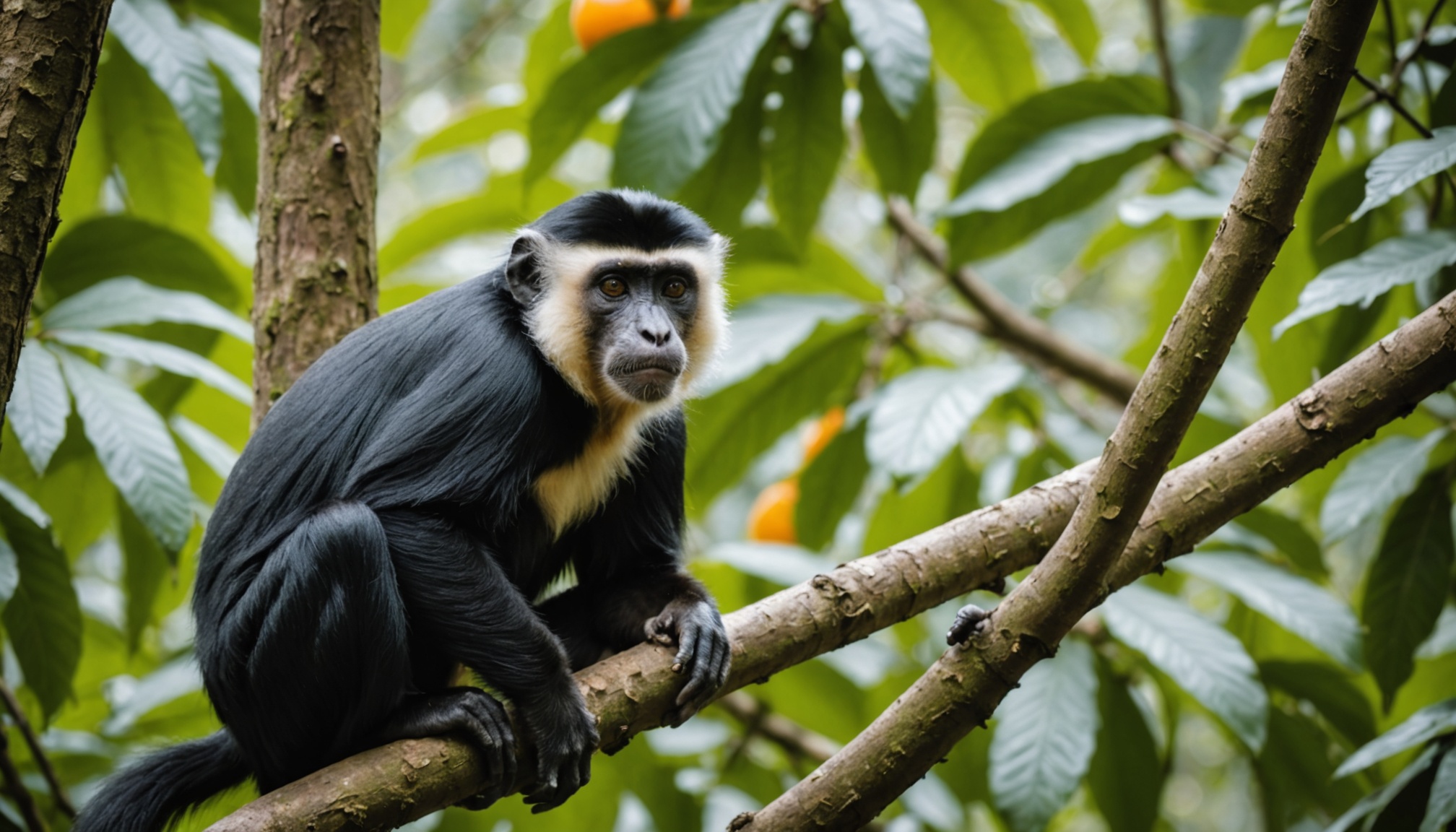
In the dense canopies of Lomami National Park, in the Democratic Republic of the Congo, scientists have just formally announced the discovery of a new African monkey. Named “Likweli” by local communities and described under the scientific name Colobus congoensis, this primate is only the fifth new monkey species identified in Africa in 75 years.
The official description, published on July 15, 2026, in the journal PLOS One, puts an end to nearly two decades of investigation. The first clue to its existence dates back to 2008, when researchers photographed a primate partially hidden in the foliage. A second sighting in 2018 revived the research and led to a dedicated mission to locate and document the animal.
A primate like no other
Smaller than most members of its genus, the Likweli sports an almost entirely black coat, contrasting with an orange to cream patch around the mouth and nose, a grayish mask around the eyes, and a clearly visible white patch under the tail. Its vocalizations, studied for four years by a team of researchers, proved markedly different from those of other Colobus species.
The animal lives exclusively in a small area of lowland tropical forest, wedged between the Lomami and Lilo rivers, in the heart of east-central DRC. A large part of its habitat lies within Lomami National Park, which helps make its protection somewhat easier.
A species already considered endangered
The description work brought together teams from Florida Atlantic University, the Lukuru Wildlife Research Foundation, Yale University, the City University of New York, as well as Lomami National Park and the Frankfurt Zoological Society. The study's authors are already proposing that the Likweli be classified among endangered species: its range is tiny, its population small, and it faces pressure from hunting and the gradual erosion of its forest habitat.
This discovery shows just how much the tropical forests of the Congo Basin, among the least explored in the world in terms of biodiversity, still harbor species unknown to science. It is also a reminder of the urgency of preserving these ecosystems, as deforestation advances in several regions of the basin.
For fans of culture and natural sciences, this announcement fits into a series of recent discoveries about the behavior and diversity of the animal kingdom. It will also interest those who follow news about wild animals and major nature tourism destinations, as the DRC is home to some of the richest forest ecosystems on the planet.
Frequently Asked Questions
Where exactly does the Likweli live?
It is endemic to a small area of lowland tropical forest in east-central Democratic Republic of the Congo, between the Lomami and Lilo rivers, largely within Lomami National Park.
Why is this discovery so rare?
The Likweli is only the fifth new monkey species described in Africa in 75 years, making it an exceptional scientific event in the field of primatology.
Is the species endangered?
Yes. Researchers are already proposing to classify it among endangered species, due to its small range, limited population, and the pressures of hunting and deforestation.
Sources
This article was written with the help of artificial intelligence. Editorial policy